Japanese macaques: why the snow monkeys bathe
The animals in the pool are Japanese macaques, and nothing about the bath is in their nature. This guide covers what they are, how a troop near Shibu Onsen learned to soak, what researchers found when they measured it, and how to behave on the path so the monkeys carry on as if you were not there.
The northernmost monkey
The Japanese macaque, Macaca fuscata, is Japan's only native monkey and the northernmost non-human primate in the world. Its range reaches the Shimokita Peninsula at the top of Honshu, where snow lies for months, and the species is built for it. A thick grey-brown coat grows in for winter, the face and rump are bare and red, and that red deepens in the cold season, which is also the mating season, from about autumn into winter. A wild macaque can live 20–30 years, though many do not reach that.
They eat almost anything the forest offers. Fruit and seeds in autumn, buds and bark in winter, insects and young leaves in spring. At Jigokudani the park staff put out grain and soybeans, with apples in season, so the troop comes down from the slopes most days, which is why a visit usually finds them near the pool. The monkeys are wild, and they go back up into the forest at night.
Rank, mothers and daughters
A macaque troop runs on rank. Every adult knows who outranks whom, and the order decides who eats first, who sits where and who grooms whom. Rank passes down the female line. Daughters inherit a position just below their mothers, and females stay in the troop they were born in for life, so the Jigokudani troop is a web of grandmothers and daughters, aunts and sisters. Males leave at maturity and move between troops, which keeps the gene pool mixed.
The troop at Jigokudani numbers well over a hundred animals, and it behaves as one unit on the slope. Grooming is the glue. Watch two adults for ten minutes and one will be picking through the other's fur, which removes parasites and settles arguments. The young spend their days wrestling and falling off things, with the adults mostly ignoring them.
How the bathing began
Nothing about hot water is natural to a macaque. The habit at Jigokudani began in the early 1960s, when a young monkey followed food into the outdoor bath of a ryokan near Shibu Onsen, found the water pleasant and came back. Others in the troop copied, as macaques do, and before long the guests were sharing their bath with monkeys. The answer was to give the monkeys a pool of their own, fed by the same hot springs, a little way up the valley. The park, Jigokudani Yaen-koen, opened around it in 1964.
Two things follow from that history. The bath is a learned habit of one troop, not a trait of the species, which is why no other wild macaques in Japan soak like this. And the monkeys use the pool the way you would, for warmth. From roughly December to March they go in most days; from mid-March the coach operator says it depends on the weather, and in summer they sit around the pool and rarely enter it. No tour promises bathing, and none can. Month by month, the pool has its own calendar.
What the hot water does for them
Researchers who followed the Jigokudani females through a winter measured glucocorticoids, the stress hormones, in their droppings. The monkeys that bathed had lower levels during the cold weeks than those that did not, and they bathed more in the coldest spells, so the pool seems to buffer the stress of winter. The same work found that the highest-ranked females spent the most time in the water and took the warmest spots, which fits everything else about rank in a troop. Low-ranked monkeys wait at the edge, or warm up in the sun.
So the bath is not play, even when the young animals splash. A soaking monkey is saving energy in a season when it lives on bark and buds. That is also why a mild March afternoon can show you a dry troop and a disappointed coachload.
Potato washing on Koshima
The clearest proof that macaques learn from each other came from a different troop, on the islet of Koshima off Kyushu. In the 1950s researchers there left sweet potatoes on the beach, and a young female they called Imo began washing the sand off hers in a stream. Her playmates copied, then their mothers, and within a few years most of the troop was washing potatoes, later in the sea, which seasons them with salt. Older males were the last to pick it up. The Koshima monkeys still do it. The Jigokudani bath is the same story with hot water instead of a stream. A youngster tries something, her peers follow, and a troop acquires a custom.
The coach with a guide who knows the troop
H.I.S. runs the day from Shinjuku with a live English-speaking guide, beef sukiyaki lunch and park entry included, about 2 hours at the pool and 13 hours in all, from ~$150. Both sites cancel free until 24 hours before.
Babies, play and why you should not stare
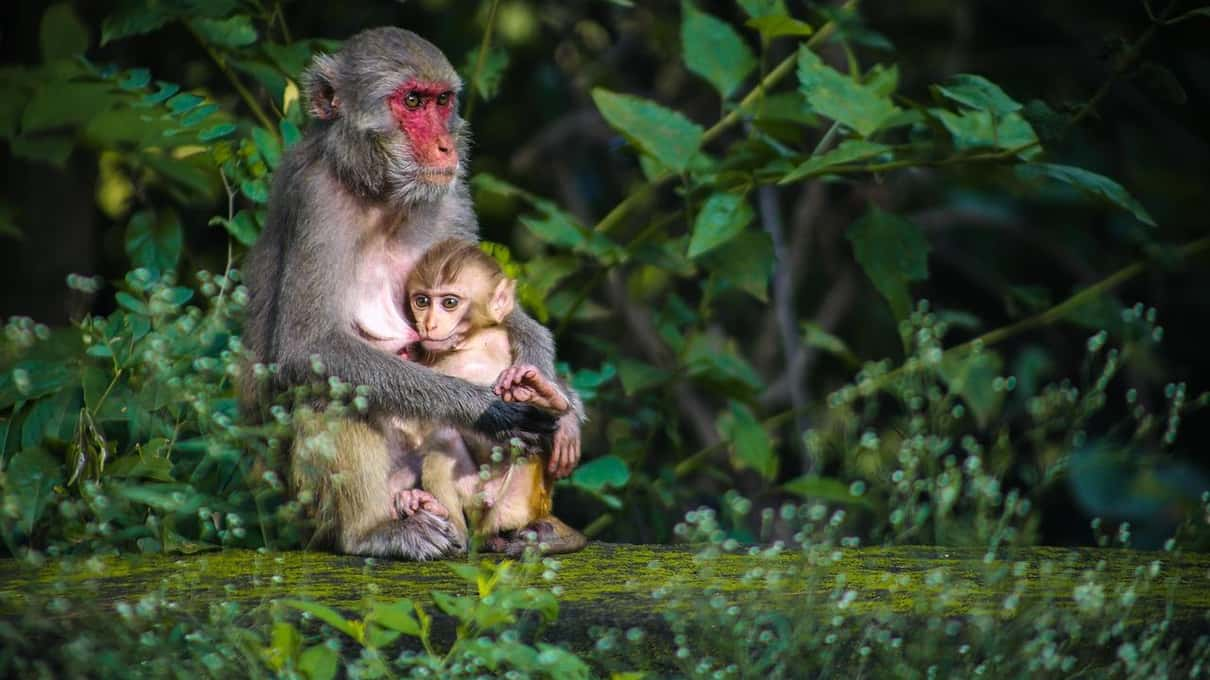
Births come in late spring and early summer, roughly late April to June. For the first weeks the baby clings to its mother's belly, then rides on her back, and by midsummer it is tumbling about with the other infants under the eyes of its mother and aunts. A summer visit misses the snow but gets the babies, and the mother-and-infant photos on the private-car listings come from that season. Young macaques also play in the pool in winter, with none of the adults' seriousness.
How you behave on the path matters more here than at most wildlife sites, because the monkeys walk straight through the crowd; a reviewer describes them weaving between visitors' legs. The rules at the gate are the species' own language. A direct stare is a threat between macaques, so look at them through a camera or from the side. Bared teeth are a threat too, so a wide grin at a monkey is a bad idea. Keep food out of sight, do not feed them, do not touch them, and leave the selfie stick in the bag, since a pole swung near a macaque reads as a weapon. The trail, the pool, the rules has the full list, and snow monkeys with kids explains it for small children.
Where else macaques live
Japanese macaques live on Honshu and on the two main islands south of it, but not in Hokkaido, whose colder forests lie beyond the strait that marks the species' northern edge. The island of Yakushima, south of Kyushu, has its own smaller subspecies in the mossy cedar forest. In Kyoto a troop lives on the hill at Arashiyama, and on Shodoshima in the Seto Inland Sea another troop has been fed by a monkey park for decades. None of them soak. If you want macaques in hot water, Jigokudani is the only wild troop that does it.
Getting to the troop
Every Tokyo tour reaches the same troop. The difference is time at the pool and the hours around it. The H.I.S. coach, from ~$150, gives about 2 hours; JTB's Shinkansen tour, from ~$293, about 2.5 hours with a licensed guide; the per-person private car, from ~$127, about 2 hours with a driver; and Luxurious Travel Master, from ~$535 per group, about an hour unless you ask for more.
On a tight budget, Cultural Tour Japan's private van, from ~$64 per person, undercuts every other private car here and brings child seats; the catch is a review count still in the low dozens, plus entry and meals on top. Anyone sleeping in Nagano can join Yadoroku's half day of monkeys, Shibu Onsen and soba, from ~$130, admission included; being Nagano-based is also its catch, since the train from Tokyo is your own job. Snow monkeys on your own explains that train, Zenko-ji, Shibu Onsen and Obuse covers the stops around the park, and what a snow monkey tour from Tokyo costs covers the money.